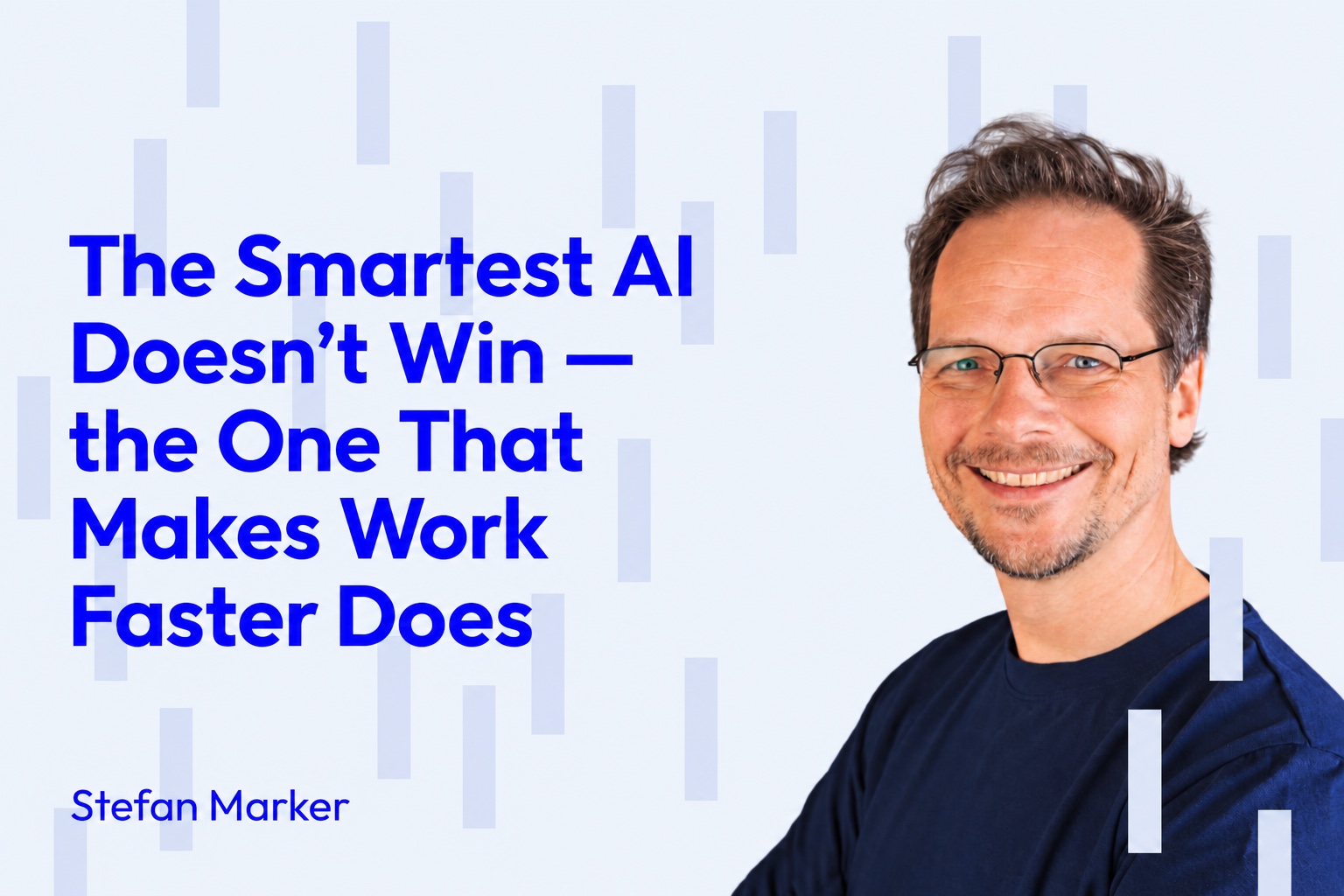
The Smartest AI Doesn't Win — the One That Makes Work Faster Does
Why the economic success of AI in small and medium-sized businesses depends less on the intelligence of individual models than on how well companies get their systems to work together.
23 October 2026 Reading time: 6 min
Contents
Why the economic success of AI in small and medium-sized businesses depends less on the intelligence of individual models than on how well companies get their systems to work together.
What does a company gain from using one of the world's most intelligent AI systems if employees still have to transfer its results manually into other systems, piece together information and work through processes step by step themselves?
For small and medium-sized businesses, this question is likely to become more important in the coming years than the question of which AI model is currently the most capable.
AI can already write text, analyse data, summarise documents and support decision-making. But there is a crucial difference between an impressive demonstration and a measurable business benefit: integration into everyday work.
From intelligent answers to business results
Many companies begin their journey into AI with individual apps. One tool creates quotes, another summarises documents and a third supports customer service. Each application promises to save time. In practice, however, they often introduce new interfaces, additional data stores and more steps in the workflow.
Consider an example from sales: an AI writes a convincing reply to a customer enquiry. But first, employees have to search through emails, copy customer data from the CRM, check stock levels separately and bring the results together manually. The AI is intelligent — the overall process remains cumbersome.
The business benefit only emerges when AI can access the information it needs and fit meaningfully into the existing workflow. Then the goal is no longer just better answers, but shorter turnaround times, fewer errors and more time for customers.
The difference is economic, not technical.
“AI cut off from this knowledge remains limited.”
Stefan Marker
The crucial question: What can the AI access?
In small and medium-sized businesses, valuable knowledge is spread across different systems: accounting, inventory management, the CRM, emails and documents, and industry-specific software.
AI cut off from this knowledge remains limited. It can offer general recommendations, but it may know neither the specific agreements with a customer nor the current delivery situation or the actual status of a project.
Companies should therefore change the order of their thinking. Instead of first asking which model is the most intelligent, they should ask:
- Where are we doing unnecessary manual work today?
- What information do employees need to carry out their tasks?
- Which systems hold this information?
- Which steps could be eliminated if AI could support work across systems?
These questions focus attention on what matters: improving the entire workflow. The future belongs not to the companies that use the most AI tools, but to those that get their systems to work together most effectively.
Why individual AI apps fall short
Companies that introduce AI exclusively through individual apps risk creating new silos. What begins as a quick improvement can lead to a fragmented IT landscape over time: applications do not communicate with each other, data has to be maintained in several places and employees constantly switch between different interfaces.
The result is the opposite of what AI promises: instead of reducing complexity, it adds another layer.
The strategic alternative is to take a broader view of the company's IT. Not every task needs a new app. It often makes more sense to connect existing systems, data and workflows through a shared platform and improve them where it matters.
Platform approaches such as Last Loop start from precisely this perspective. The focus is not on an individual AI application, but on how existing systems and processes can be brought together and improved. AI becomes part of the way the business works as a whole, rather than another isolated tool.
This requires planning, clear access permissions and a carefully designed relationship between systems. But it creates the foundation for individual improvements to work together, rather than simply sit alongside each other.
“Only when technology works together does artificial intelligence become a real business advantage.”
Stefan Marker
The key metric is time saved
For small and medium-sized businesses in particular, where budgets, staff and time are limited, AI has to be measured by concrete results. Are quotes prepared faster? Are customer enquiries answered sooner? Does it take less effort to find information? Can employees take on more work that adds value?
This does not necessarily mean replacing jobs. The greater benefit often lies in making better use of existing capacity: less administrative routine and more time for advice, quality, innovation and customer relationships.
The future of AI in small and medium-sized businesses will therefore not depend solely on increasingly powerful models. What matters is how well companies develop their existing IT as a whole and use AI where it makes a measurable improvement.
Before companies test the next AI app, they should ask a different question:
Which of our systems can this AI actually access — and what work can we do faster, more easily or better as a result?
The most successful companies will not necessarily be those with the most intelligent AI or the largest number of AI tools. They will be those that get their systems and processes to work together most effectively. Only when technology works together does artificial intelligence become a real business advantage.
 Stefan Marker
23 October 2026
Reading time: 6 min